
This holiday weekend while online I saw an article about the new GAP logo that was revealed on October 4th and the criticism the popular retailer is receiving for it. Now that I’ve had a chance to compare the two logos, I think that I am partial to the old one, only because it is what I grew up with. It gives me a warm fuzzy feeling of happy days and buying cool clothes…..it brings me back to my University days. I guess I’m not the only one feeling this way. According to the Yahoo article this morning, this comment from a Facebook user is typical of the online response: “By changing it, you’ve completely destroyed what it took 20-plus years to build.” I wonder what is the average age of those who dislike the new logo. I’m curious…which one do you prefer?
The 3D TV Phenomenon
By now just about everyone has seen a 3D movie in the theatre, it’s pretty hard to avoid seeing one anymore. We’ve been hearing about 3D television for over a decade now, but finally it is available in nearly every store you walk into. I was recently out looking at televisions and was amazed at how well these TVs, with the flick of a switch, create a 3D cinema-like effect. As I was looking I began to wonder what it would be like to watch a 3D television every day — would my eyes adjust to them? Perhaps I am just not used to it yet, I feel a little off balance after watching a 3D movie. I got to wondering what kind of strain it would put on my eyes long-term. I considered all of these things, even though a 3D TV is far from being in my budget.
I decided to head to trusty Google and see what people were saying about it. I was shocked to find quite a lot of controversy over the issue. Apparently there have even been warnings issued by the manufacturers to avoid use if you are in poor health, tired, or drinking alcohol, under the age of 6 or over the age of 65. I’m sorry but that is just not cool, the only time I watch TV is when I am tired or not feeling well.
Customers are also cautioned to immediately stop watching 3D pictures and consult a medical specialist if they experience any of the following symptoms: (1) altered vision; (2) light-headedness; (3) dizziness; (4) involuntary movements such as eye or muscle twitching; (5) confusion; (6) nausea; (7) loss of awareness; (8) convulsions; (9) cramps; and/or (10) disorientation. Parents should monitor and ask their children about the above symptoms as children and teenagers may be more likely to experience these symptoms than adults.
Groups considered to be at high-risk for these side effects are; pregnant women, young children, teens, the elderly, people prone to seizures or stroke, people prone to dizziness or motion sickness, people with eye problems, people who are out of shape, and people who have been drinking. It has also been attributed to damaging people’s depth perception.
At this point I got to thinking, am I talking about television or the side effects of medication?! Cool as 3D is, and as much as I enjoy it in the theatre every now and then, maybe its best to wait a little while longer with my HDTV and let this technology develop. In the mean time, perhaps we should pass a law about driving under the influence of TV.
– Sandra
Summer Holidays
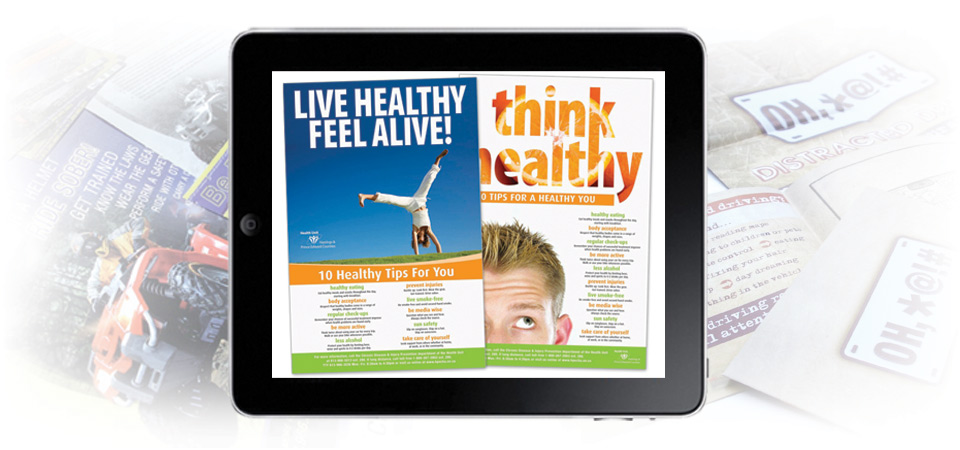
It’s summertime and you know what that means – summer holidays! I had the best vacation last week. I went to Minden (near Haliburton) and spent my days relaxing by the water on South Lake while spending time with close friends. I noticed that on long drives I like to read the signs that are dotted along the side of the highway – they are good reading material! While driving back through Bancroft, I decided to try find the Tim Horton’s, which was harder than it sounds. While I was sitting in the drive-through I saw the Be Realistic Not A Statistic sign we designed for the Hastings and Prince Edward Counties Health Unit. What a nice surprise! That’s not it, though. I also saw another sign we designed while driving South on 62 towards Belleville – Speeding Costs You Deerly (another Health Unit initiative). Very cool. It’s nice to see the work we do actually put to use out in the public. It made me feel good. Needless to say I took pictures of both for you to view. I hope enjoy the rest of your summer!
—Kathy
Art or Marketing, you decide!
Yesterday, Mashable featured a piece on a new video where a “Guy Walks Across America” that is quickly hitting viral status. At first glance, it seems like a project that can be considered a work of art. I have a hunch that this may be a subtle marketing campaign, but you be the judge:
Now that is interactive
A clothing/fashion store opened last June in Times Square. What caught my eye was the way they created a billboard that not only drew a crowd, it (at least on some level) interacted with them. From NYClovesNYC:
“The enormous store provides Times Square with a high-tech 61-foot digital billboard featuring virtual models who interact with the mesmerized crowd in front of the store, sometimes taking a Polaroid photo of the crowd and showing it to them, or picking up an individual from a crowd and turning him into a frog by a kiss or dropping him into a shopping bag.”
It kind of reminds me of the Jaws movie billboard in Back to the Future II
Did Hollywood have it right? Is this the future of environmental advertising – or is it just a gimmick?
- Shaun
New Internet Spice

Last week, the internet saw one of the most popular viral campaigns of all time! Old Spice teamed up with Wieden + Kennedy to bring “The Man Your Man Can Smell Like” guy, portrayed by actor Isaiah Mustafa, to fans by creating a series of personalized Youtube responses.
How great was this campaign for exposure?
In a 24 hour period, they were able to get:
• 180+ videos created
• 5.9 million views
• 22,500 comments
We can compare this to other notable viral videos and see that it beats out influential people like Obama and Bush.

I will have to agree with Iain Tait, Wieden + Kennedy’s Global Interactive Creative Director , when he says, “In a way there’s nothing magical that we’ve done here, we just brought a character to life using the social channels we all use every day. But we’ve also taken a loved character and created new episodic content in real time.”
They used many of the principals for social media success that have been discussed thoroughly around the internet. This campaign engaged consumers, added value to their lives, was created in a human voice and was done in a timely fashion. Let me explain:
Engage Even if the personalized was response wasn’t written directly to you, it still felt like he was in your bathroom answering questions.- Add Value This is something that consumers had never seen before, a global national brand reaching out to its consumers through a ‘brand mascot’. You simply HAD to tell all your friends that would care!
- Human Voice Even though it was a global-national brand, it felt more like a simple sketch comedy bit. It felt real, it felt human.
- Timely The fact that these responses were sent out in real-time is unbelievable and makes this campaign a huge success – it was about conversation.
I am hard-pressed to call this campaign a success, yet. I would still want to see how this campaign had an impact on sales before we start creating case studies that will be looked at until the end of time. I have no doubt that there is a positive influence on the bottom line, but at the very least I think this campaign has reinforced the “new and youthful” revival to the Old Spice brand. I also believe that this has opened up a chasm of potential in how brands can now communicate with their consumers.
What are your thoughts?
Creative or Crazy?
I used to live in a small town in Southern New York. In June of 2007 someone decided that it would be a great idea to raise money for charity while advertising for local businesses. This was accomplished using four-foot tall fiberglass squirrels. You know, kind of like the moose you see sometimes around Toronto, but not really. In Olean, NY, a person, or business could purchase one of these squirrels and customize it however they pleased. These sculptures were then places all over town, in front of businesses, along the streets, in parks, you name it, there are squirrels everywhere. To date there are twenty-five squirrels and counting.
Many businesses decided to decorate these squirrels as part of their local advertising. It was a visible sign of their contribution to the community. Interesting idea, in my opinion, perhaps a good idea gone wrong. Part of what made it so funny was you
could walk down the street and see five squirrels before you would meet another person. I used to live just down the street from Ronald McSquirrel, I have to admit it never really made me want to go to McDonnalds. Had it not been located right across from the police station I would have put a paper bag over its head. Honestly, check it out! It is a little creepy.
Okay, seriously though, despite my little rant about the squirrels, I love it when people come up with innovative ideas. I also love to see businesses getting involved in the local community. I might not be a big fan of this particular project, but I can’t argue with the fact that everyone talks about it. We take pictures of them, and I personally can’t deny a few late night Olean squirrel-hunting adventures. I have to acknowledge that in many ways Olean’s “Woodland in the City” campaign seems to be a success, and they have raised a lot of money to build a museum for children downtown. So tell me what you think, creative or crazy?
A Funny Billboard
I was driving home from work the other day and I laughed out loud when I saw a billboard for Gay Lea Spreadables. I had to pull over and take a picture of it! Take a look – who hasn’t had this happen to them? Too funny. I was curious and checked out their website gaylea.com. They have a sponsorship program on now which supports the Daily Bread Food Bank – a non-profit, charitable organization that is fighting to end hunger in our communities. You know, it’s not the first time I’ve been impressed by a billboard on my way home from work.
Print media isn’t just limited to the office. Out-of-Home products such as posters (or billboards), superboards, transit shelters, wall murals, bus, subway and streetcar advertising are all powerful ways of reaching today’s consumer. CBS Outdoor is who we send all of our outdoor billboard designs. For information on any of the products they have please visit cbsoutdoor.ca
I remember one billboard in particular that proves the effectiveness of strategic planning when it comes to choosing a location. A few months ago, McDonald’s was advertising FREE COFFEE when Tim Horton’s had their “Roll Up The Rim” contest on. The billboard for the free coffee was located right across the street from a Tim Horton’s. I thought that was genius! Needless to say, I went to McDonald’s for my coffee those two weeks (and maybe a couple of lunches). I even went onto their website and was reading about their nutrition information and community involvement, and I now have a better opinion of the restaurant chain. Tim Horton’s has similar information on their website, and the Gay Lea website has an environmental sustainability report available to view. It’s nice to see large business caring about their community.

Billboards speak to each consumer differently. What I find funny, or smart, might seem silly to someone else. That doesn’t matter, however. The fact remains that the billboard DID speak to me, and I’m still thinking about it! Have you seen any unique billboards lately? I’d like to hear about it.
If you’d like to see the billboards Engine has designed, you are welcome to view our portfolio online.
—Kathy
Square: bringing us closer to a cashless society.
Okay, so honestly how many people really carry cash on them anymore? I mean sure, we all keep maybe twenty bucks on us for coffee, parking or to pay back a friend for lunch, but do we really pay for most things with cash? Of course not! We have become so accustomed to the convenience of the swipe-and-go world we live in. We pay at the pump, auto-charge bills to our credit cards online, and I know everyone of us has swiped a credit card for something under 2 dollars at least once! In 2008 VISA alone reported $90.2 Trillion dollars of spending worldwide.
We are almost a cashless society, except when we are paying other people back for things. Usually we have to run to the ATM and get cash. Thanks to the development of Square last year, all of that is about to change. 
Square was first announced in late 2009 but as of last month it is has been released to the public and is fully available to all consumers. (within the US)
It is official, now debit and credit transactions are easily accessible to everyone right from their android-powered phone, iphone, or ipad. Within seconds you can turn any of them into a cash register. Cash can be exchanged with any individual, right from your phone. This is an application that is targeted to individuals and small businesses more so than large corporations. All you need to do is download the Square application, plug a small device into your headphone jack that reads the magnetic strip on a debit or credit card, and you are ready to go. The phone acts as a credit terminal, sends an email copy of the receipt to the buyer, and logs the transactions for the seller on their phone. Along with all of this Square also maps out the location of the transaction. The possibilities of this type of technology are really endless.
After I get over imagining the endless possibilities, my first thought is, how do I know what other people are doing on their phones. It seems like this concept is amazing, but perhaps needs more development to really be a practical way to exchange money with strangers on a day-to-day basis. How hard would it be for someone to figure out how to copy my debit or credit information right onto their personal phone.
There is also a lot of concern that this application will be highly attractive to people who are unable to get standard business accounts because of a bad credit history or fraud.
I am not sure what to think about the security risks, but I do think square is a great development that we will see becoming more and more common in the near future. In the mean time I think there are a lot of security kinks to be worked out.
Check out the promo video for Square
— Sandra
What are Microformats and why should you have them?
Here’s my tiny explanation of Microformats, how to use them, and how they can help futureproof your website.
To understand how Microformats work I’ll use an illustration; a website is like a recipe containing instructions on how your web browser should build and display the website. This is written in a language called HTML. Microformats are a subset of HTML that tell the web browser what type of information is on the page instead of just displaying the information.
Think of it like a recipe inside of a recipe, like a pizza recipe that contains a complete recipe for pizza crust inside of it. If it’s marked clearly enough, you could easily pull that pizza crust recipe out from the pizza recipe and use just that if you wanted.
What microformats are most popular?
The most popular Microformats are Address cards, Calendars, Product Reviews, Resumes, and Tags, and they’re all relatively easy for a professional to add to your site.
Why should you use them?
Microformats have existed for a few years now and so many large websites (Google, LinkedIN, Twitter, Youtube, Wikipedia) are already slowly adding support for them.
When we revisited our recipe pages on FoodNetwork.com a few months ago, it was one of our priorities in Front End Engineering to embed hRecipe. We knew that it would be only a matter of time for tool support to come along to utilize our recipe data. As Front End Engineers, we have real control over what are pages output, and we have a real opportunity maximize the amount of data that a tool like Google can glean from our markup. It would be a poor practice to not take advantage of microformats when something as powerful as Google recognizes their importance.
Says Mark Wunsch, a developer for Foodnetwork.com, read the rest of that article
At the same time people are slowly extending web browsers or adding support for Microformats to web services. If you’re a business then your location will be far easier for web-based services to find you if you contain your business information in an Address card (hCard). Some web browsers and web browser plugins can already detect any Microformats on a website and allow you to pull them out of the site and save the information on your computer or add it to your Address Book.
Sooner or later everybody will be using Microformats and you too will have them on your site – but if you’re the first of your competitors to embrace this technology then for a while you’re far easier for people to find – isn’t that reason enough?
Who can make Microformats?
You can, if you have an understanding of basic HTML. Otherwise any web designer worth his salt can make one for you; it’s not difficult and doesn’t take too long to do it properly, but the advantages (especially right now if you’re an early adopter) are well worth the investement. It’s always easiest to hand-craft your microformats, but go ahead and check out the free tools available at microformats.org/code-tools
Where can I find out more about Microformats?
The home for all discussion of Microformats happens over at microformats.org