



You are currently browsing the Engine Communications blog archives for January, 2010


Case Study: Changing behaviour one tweet at a time?

42-15655080

Are you creating a call to action, or simply talking to hear yourself speak?

Two incidents last week in the world of social media piqued my interest as to the value associated with spreading a message online. There’s been lots of discussion on the topic of viral marketing–using preexisting social networks to increase brand awareness or achieve other marketing goals–so I won’t talk definitions. However, using these two cases to highlight the pros and cons of our cache of marketing tools is never a bad idea.

The first issue arose on Wednesday, when the New York Times revealed that H & M had been destroying new, unworn clothing that it couldn’t sell. Needless to say, people were outraged. After a brutal recession, and in the middle of winter, rather than donate these items to charity, H & M had the gall to throw them in the garbage. Apparently Wal-Mart does the same thing, as do many others in the for-profit production system.

When this story hit the social media world, it went viral. Twitter lit up with tweets and retweets about the incident–none of of which were positive, or in defense of the retailer. The blogging, sharing, and passing on of this story must have hit thousands of people online. It became a PR crisis for H & M, and one that they addressed pallidly, albeit promptly, saying that it wasn’t “standard practice”, and it wouldn’t happen again.

We could discuss this issue ad nauseam from a public relations standpoint, and I still might in a future post, but right now, let’s focus on the spread of information online. The second case also involved a viral message, but this one was found on Facebook.

On Thursday of last week, you may have noticed a strange trend: Many of your female friends changing their status line to their bra colour to raise awareness for breast cancer. No one quite knows where the message originated from, but it reached viral status quickly, with the Susan G. Komen Breast Cancer Foundation Fan Page going crazy with new fans and updates. The Toronto Star reported that the page went from 135 members to 700 within hours, but today, it’s at over 141,000 fans! That’s viral marketing in action.

However, it bodes another question that I think is more important: Does the online transfer of information change the behaviour of your target audience?

The case of the H & M debacle created a movement that changed the behaviour of the retailer (at least for now). People (many in their target market) got angry, voiced their concern, and the target audience (H & M) had to take action. In this case, apologize and remedy the situation. Here we see viral messages creating a call to action, and a level of awareness, that had to be addressed by the party in question.

The breast cancer bra colour “campaign” definitely spread a message, but did it have a real-world affect? Some might say that increasing awareness equates with reaching an objective. I would agree that that’s the case if there had been a concerted effort on the part of a legitimate cancer-related organization to organize this campaign, but it just wasn’t so. As the origin of the message is unknown, there’s no way to track the communication process. There were no goals set, there were no measurable objectives–it was just an idea.

Now I love ideas, but I don’t think an idea alone results in action. Isn’t that what we want viral marketing to be about?

A spokesperson from the Susan G. Komen Foundation said that they don’t care whether the campaign raised money or not; if it leads to more women getting mammograms, and lives saved, while people have fun, then that’s enough. I tend to disagree–it’s not enough because there’s nothing to prove that any of this awareness will change the behaviour of the women involved.

Whether in the for-profit or non-profit world, don’t we want that information to be a call to action? Shouldn’t we expect not only brand awareness, but increased revenue or donations, recruitment of new volunteers, etc.? These are just some of the questions that these two incidents should have us asking.

What I love in both cases is the spread of information. What I think is lacking, especially in the bra colour example, is the means by which to track and validate our claims that awareness leads to action. Anil Dash touched on this subject last week in the context of his personal Twitter account. Quantity doesn’t equal quality, nor results.

The moral of the story? If we’re to successfully drive online marketing campaigns, we need to stick to the basics: Define your target audience, set measurable goals, and devise a way to evaluate the success of the campaign.

What do you think? Is awareness an end in itself?

Happy New Year to All!

Spice (like paprika) adds flavour to dishes, so you can skip the butter and salt. (In theory.)

Spice (like paprika) adds flavour to dishes, so you can skip the butter and salt. (In theory.)

Wow, what an awesome break, almost two weeks off–perfect! Just enough time off to enjoy family and friends, and just enough time off to really be ready to send the kids back to school. There’s that routine thing rearing its head again. Thank goodness for routines.

With the new year, comes my least favorite tradition, the “New Years Resolution”. The pressure of coming up with something that is truly going to make a difference in your life? Come on, do we really have to do this? I’m just chicken because I know that I’m no good at keeping them–resolutions that is.

So here it goes, I want to try to cut back and make some simple changes to my eating habits. No, really, I mean it…. Easier said than done, I know. I think that the key here is not to overdue it. So many people make resolutions that they can’t even come close to keeping; me I’m going to start off small.

Things like less salt and butter (killing me just talking about it, I love my salt and butter. Food just tastes so much better with it!); incorporating fish into our diet a few times a week; and one more–eating breakfast. I never eat breakfast. I’m too busy making sure that my kids eat theirs and have a healthy lunch packed. By the time I’m done this, my breakfast plans are out the window, or more like out the door.

Sitting down to the table twice a day as a family is a good thing. It means that I am looking after myself as well as my boys! If anyone has some good quick breakfast recipes, please share, I really need some help in this department.

Good luck with your resolutions, and remember, keep them simple and don’t stress!

In keeping with my resolution, I thought that I would share a salmon recipe that I made recently.

paprikaRubbed Salmon With Smoky Maple Glaze

Smoky Rub

  • 3 tbsp firmly packed brown sugar
  • 2 tbsp smoked paprika
  • 1 1/2 tsp cracked black pepper
  • 1/2 tsp onion powder
  • 1/2 tsp of cumin
  • 1/4 tsp cayenne
  • 1 tsp salt

Mix all ingredients together and keep in airtight container or jar. Recipe makes a fair amount so you can keep and use in other recipes. (Awesome on ribs)

  • 4 skinless salmon fillets
  • Olive oil for brushing on fillets
  • Smoky rub
  • Maple syrup – just enough to drizzle over salmon

paprikasalmonRinse and pat salmon pieces dry with paper towel. Place salmon on a baking sheet lined with foil (makes for easier clean up). Brush salmon with olive oil and then rub with smoky rub to cover top of salmon and drizzle pieces with maple syrup. Bake in 350 oven for 25 – 35 minutes depending on the size of the salmon. Broil for an additional 5 – 7 min. to get the top brown & crispy.

Enjoy with wild rice and steamed veggies of choice.

Wine – if you prefer red wine, I would suggest a Pinot Noir as it is a lighter red. A nice buttery chardonnay would pair really well with the meaty fish.

Cheers,

Kerry

Website Accessibility

42-15645269There’s this one women’s washroom in a restaurant (which shall remain nameless) here in Belleville that really irks me. I’m a pretty small woman, but the narrow L-turn in the hallway leading into it, bookended by two doors which open in the wrong directions, makes it really difficult to maneuver. Everytime I go through this obstacle course I think, “What would I do if I were in a wheelchair?” It’s ridiculous.

But it illustrates a good point: How easy is it for people with disabilities to access your business?

As you may, or may not know, January ushered in the dawn of a new era of Accessibility for Ontarians with disabilities. Under the Accessibility for Ontarians with Disabilities Act, 2005, the government has taken it upon themselves to develop standards of accessibility, and to enforce them.

It’s about time. It boggles the mind that in 2010, people with disabilities still do not have equal access to services, employment, transportation, and information. But all of that is about to change, and the first target for reformation is the world of customer service.

As of January 10, 2010, all public service sector organizations (ie. government, hospitals, school boards) must be in compliance with these standards. By January 2012, everyone else has to be on board.

The standards include things like enacting policies and procedures for providing goods and services to people with disabilities. It also encompasses training staff and volunteers in accessibility issues. Another key element of these standards is in regard to communication: website accessibility.

What is website accessibility?

Many people with disabilities rely on computers and the internet as sources of communication. Assistive devices, such as screen readers, speech input systems, and others operate with their software to provide an optimal experience. Making your website accessible means that it is built to be compatible with these tools.

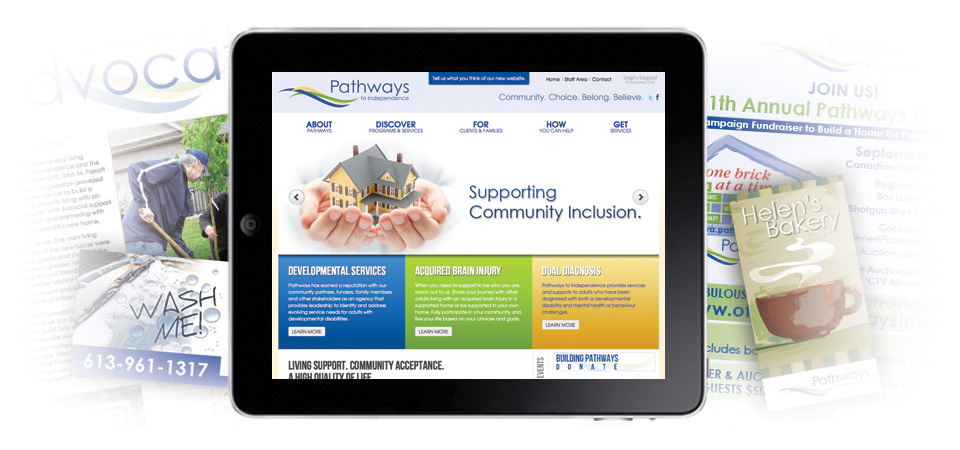
There are different levels of accessiblity for the web. Most businesses with be able to stop at the ‘A’ level, but others, like our awesome clients, Pathways to Independence, will want to take it a step further. It all depends on what your site is doing, who it’s reaching, and how accessible you feel you need to be (it would be pretty cool if everyone was at ‘AAA,’ but maybe someday.)

We here at Engine have been talking about website accessibility for awhile. You can check out a quick slideshow presentation we did on the topic on our Slideshare site.

In the meantime, consider the implications for your business. Check out the following resources:

Ministry of Community and Social Services, Ontario – AccessON

WorldWideWeb Consortium – Web Accessibility Initiative

Wikipedia – Web Accessibility

Feel free to call, email, tweet or Facebook us with any questions you might have. We’d be happy to help!

The Future is Now

retro_space_11The start of any new year brings with it certain emotion: hope, excitment, excpectation. People want to set their sights on things to come, and raise the bar personally and professionally. Yes, most times these resolutions are made with an awareness that what we want might not be what we actually get. However, the consensus seems to be that 2010 feels different. There might be good reason for this–especially in business.

2009 was ripe with innovation in technology, media and marketing. In one year, over 100,000 iPhone apps were created. (And if you didn’t know, word on the street today is that for a mere $200 US you can create your own.) According to social media source, Mashable, YouTube sees over 100 million monthly views. In an eight month span Facebook doubled its size: from 100 million to 200 million users. The release of James Cameron’s new movie, Avatar, was heralded by a highly integrated social media PR campaign. And if we got into the heavy stuff, (ie. Iran elections, Obama’s presidential campaign) we could talk for days about how social media has affected how we live.

The implications for business are astounding. But don’t take my word for it.

Here’s what’s being said of a new year in business, marketing, and all things social (for your Monday reading pleasure):

Social network economy leaving business behind - Toronto Star

The 10 players who will shape technology law - Toronto Star

Five tips to manage Facebook’s new privacy settings – Globe and Mail

Media trends for 2010 – The Guardian

‘Washington Times’ cuts staff 40% - MediaDailyNews